SUMMER TALKS - 2026
- Thursday 30th July: The first of our Summer talks for 2026 was entitled ‘What's in a Name? English "Dramatick Opera" in the Restoration and Beyond’ with Leonie Krempien who received MA degrees in both musicology and English Literature in 2024. She is working on a doctoral dissertation in musicology at the University of Mainz, Germany, looking at Emotion in London Baroque Opera between the death of Henry Purcell (1695) and George Frideric Handel's first successful Italian opera for London, Rinaldo (1711).
A "semi-opera" or "dramatic(k) opera" is a form of play with musical episodes that enjoyed enormous popularity on the London Restoration stage – and practically nowhere else. Prominent writer and music lover Roger North called it "semi-opera", as in, half an opera, in the 1720s, and the disparaging name has stuck since then. However, this theatrical practice fascinated people such as John Dryden and Henry Purcell, and some of their best-known works, such as King Arthur and the Fairy-Queen, are in the genre. We will explore how "dramatick opera" was conceived, what made it prevail against attempts to introduce fully sung French- and Italian-style opera in London for almost 40 years and, how much of that might be the fault of one William Shakespeare. - Thursday 13th August: The second of our our Summer talks was entitled ‘Sir Winston Churchill and his antics’ with Howard Slater who is a retired qualified lecturer and has been giving talks for over 30 years. He also leads guided walks around London. He has researched his subject closely and will use photographs to illustrate this talk on Sir Winston Churchill.
This talk will cover Sir Winston Churchill's life story (30 November 1874 - 24 January 1965) including the different phases of his life and times and his exploits. - Thursday 27th August: The last of our Summer talks was entitled ‘Turner and Constable: Rivals or Brothers in Art?’ with Nicole Cochrane who is an art historian and curator, specialising in the history of art, collecting and museums from the eighteenth century to the present day. She is currently Assistant Curator in Historic British Art (1790-1850) at Tate Britain where she was assistant curator on the exhibition Turner and Constable: Rivals and Originals.
To coincide with Tate Britain’s blockbuster exhibition Turner and Constable: Rivals and Originals, this talk explored the intertwined lives of two of Britain’s most beloved artists. It looked at some of the star works throughout each artists' career, looking in particular at the moments of rivalry, tension, and camaraderie between these titans of British landscape painting to explore how both have left their mark of the artistic tradition, continuing to be beloved and relevant to this day.
SUMMER TALKS - 2025
- Thursday, 7th August : ‘The Most Heroic Failure of Modern Times: Shackleton’s Antarctic Expedition’ (*). When Ernest Shackleton set off to cross the Antarctic for the first time in 1914 he was already a celebrated explorer, but his ship quickly got trapped and then crushed in the ice. He and his crew camped for months on the ice with only rudimentary supplies, until he decided to sail a lifeboat 750 miles to South Georgia – a feat never before attempted. Arriving exhausted they had to climb a mountain range before eventually finding a remote whaling station and ultimately returning to rescue their comrades. Shackleton’s leadership became the stuff of legend; this talk explains why. With Jeremy Holmes, who went from Grammar school to Oxford where he won a Scholarship and took a Double First in English Literature. Later, when he was CEO of the Royal Pharmaceutical Society, he was given a book on leadership which used the story of Shackleton’s heroic 1914-16 expedition. He found it inspiring, and now in semi-retirement, he talks about it and other subjects to various groups.
- Thursday, 28th August: The second and final Summer talk was entitled ‘Widows of the Ice’ (*): it told the story of Scott’s Antarctic Expedition of 1910-13 through the experience of the three wives whose husbands did not return. Kathleen Scott, Oriana Wilson and Lois Evans were three very different women who were united briefly by their grief. As the world lionised their heroic husbands and venerated their sacrifice, the widows and their children had to suffer and survive. With Anne Fletcher who read history at Oxford University. She has a successful career in heritage and has worked at some of the most exciting historic sites in the county including Hampton Court Palace, St Paul’s Cathedral, Westminster Abbey, Bletchley Park and Tower Bridge.


SUMMER TALKS - 2024
Details of the talks are shown below. All of these talks were recorded - this is indicated by (*) after the talk name - and can be accessed on the Ealing U3A YouTube channel. For information on accessing these talks recordings please contact the Webmaster.
- Thur 29th August - From Primordial Soups to Primates in Suits: The Evolution of All Life on Earth (*) (Life evolved more than 3.5 billion years ago, and today humans share the planet with around 12 million other species. David has set himself the difficult challenge of telling the story of the evolution of all life on earth in 1 hour. Can he explain the origins of life in the oceans, the evolution of millions of species, the extinction of millions more, and the rise to dominance of Homo sapiens, in just 60 minutes? No, he can’t but it’s still a good talk) with Dr David Jones who works at the Natural History Museum in London and lectures at Imperial College. He is an entomologist specialising in rainforest insects and soil ecology. He has done fieldwork in 18 countries including Indonesia, Papua New Guinea, Gabon, Madagascar and French Guiana. He has published more than 50 research articles in scientific books and journals.
- Thur 15th August - The Origins of Mathematics (*) (Where did our maths come from? What number systems were used? What calculations were carried out, and how accurate were they? What problems were tackled, and why? This illustrated talk introduces the mathematical activities of ancient Egypt, Mesopotamia, China, India, and the Mayans in their historical contexts. No technical mathematical knowledge is assumed) with Robin Wilson who is an Emeritus Professor of Pure Mathematics at the Open University, Emeritus Professor of Geometry at Gresham College, London and a former Fellow of Keble College, Oxford. A former President of the British Society for the History of Mathematics, he has written and edited over 50 books on the history of maths (including Lewis Carroll in Numberland) and on graph theory (including Four Colours Suffice, on map colouring). Involved with the popularization and communication of mathematics and its history, he has received awards from the Mathematical Association of America for his ‘outstanding expository writing’, and for his outreach activities in the subject.
- Thur 1st August - Mad, Bad and Dangerous to Know: Lord Byron and his Women (*) (Lord Byron wasn’t just a poet, he was a rock star. The most prominent and outrageous celebrity of the Romantic era, he lived life to excess – but his relations with women were scandalous and often appalling. This talk explored those relationships in the context of the social conventions of the time, Byron's extraordinary rise to fame and legend, and his unparalleled notoriety for drink, sex and rebellion) with Jeremy Holmes who went from a grammar school to Oxford where he won a scholarship and took a Double First in English Literature. He then had a career in advertising, economics consultancy and as CEO of the Royal Pharmaceutical Society, before working in Higher Education. He is now retired but is a charity trustee and gives regular talks on a range of literary and other subjects.


SUMMER TALKS - 2023
Our Summer Programme talks for 2023 covered a range of topics with some distinguished speakers. These talks were all 'hybrid' meetings with an audience in Ealing Green Church and with the talk broadcast over Zoom to u3a members watching at home. Details of the talks are shown below. Most of these talks were recorded - this is indicated by (*) after the talk name - and can be accessed on the Ealing U3A YouTube channel. For information on accessing these talks recordings please contact the Webmaster.
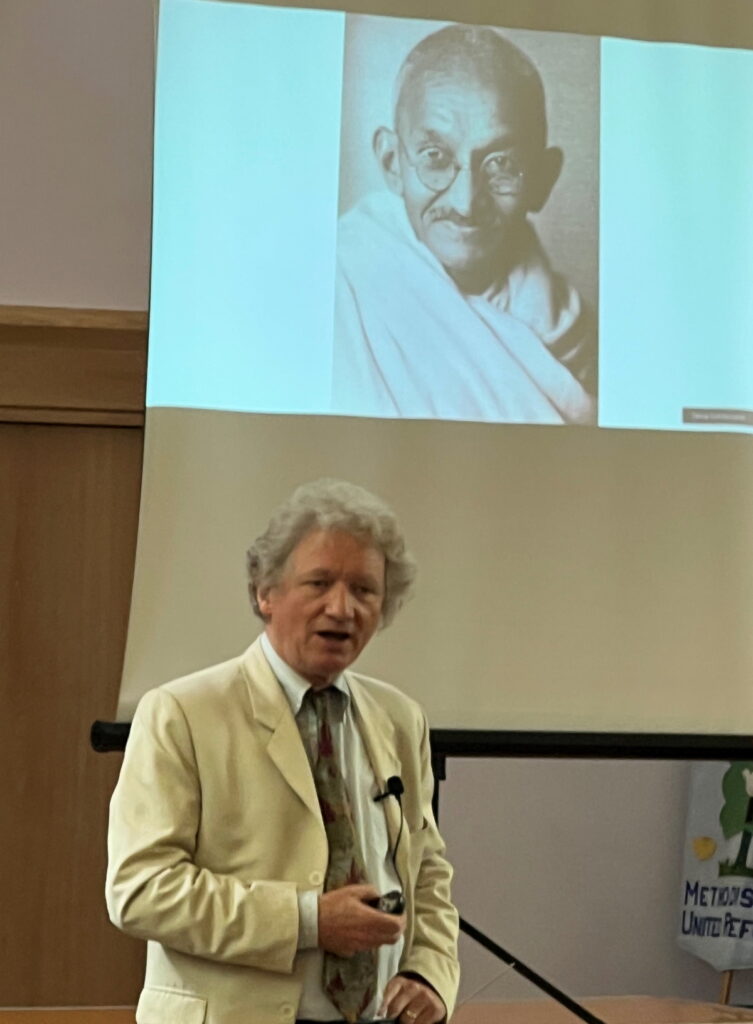
- Thur 24th August - Gandhi vs Churchill: Triumph and Disaster at the End of the Raj (*) (While Stalin and Hitler were killing millions, a small, shy Indian, defying Churchill, relieved the British Empire of its crown jewel without so much as picking up a stone. How did Gandhi do it? What can we make of his legacy today? And why was Winston Churchill, so effective as a war leader, impotent to stop him? This talk was inspired by Peter’s novel India Be Damned, which focuses on the independence and partition of the Indian subcontinent as experienced by foreign correspondents; Mahatma Gandhi is a major character in the novel) with Peter Popham, author and journalist, who was the correct answer to the University Challenge question, ‘which British journalist wrote two books about Aung San Suu Kyi and Burma?’. Formerly a foreign correspondent and columnist with The Independent, Peter's book The Lady and the Peacock was a global best-seller. His new novel India Be Damned, in which Gandhi plays a key role, has been called ‘a masterpiece’, ‘a must-read’, and ‘powerfully evocative’.
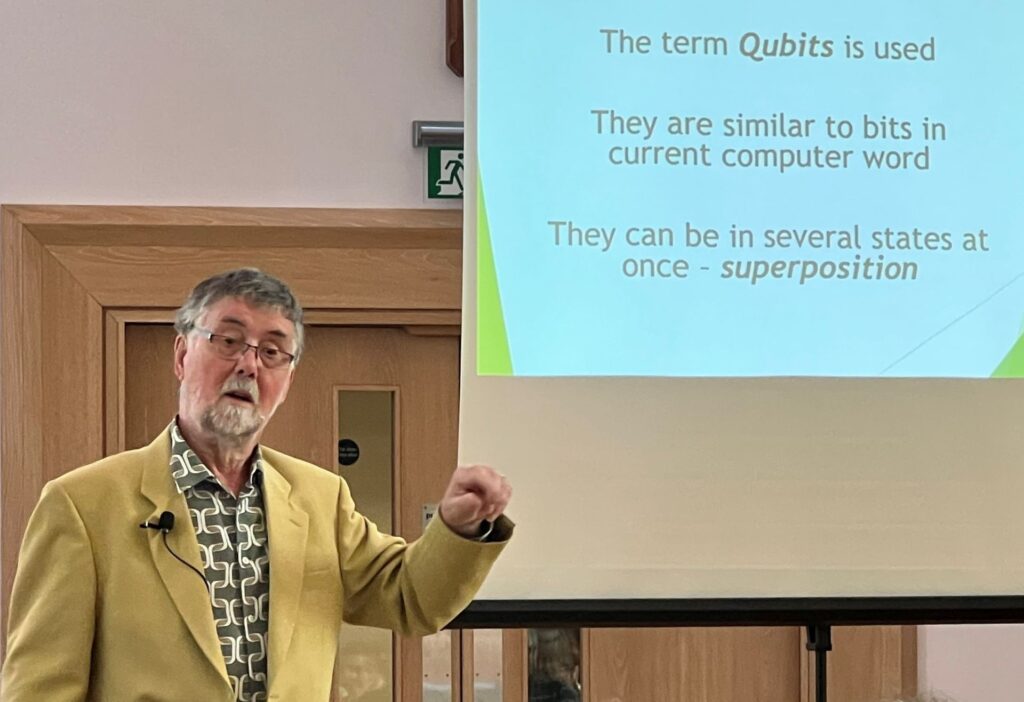
- Thur 10th August - The History of Computers (*) (This talk covered the individuals who thought of using machines to automate calculations, how they did it, who got there first and some of the problems they faced. It also discussed what lies ahead in the world of computers) with Charles Coultas who started his career in computers as an engineering student at Hawker Siddeley in Loughborough in the 1960’s. Charles later worked on supporting the first second-generation computer: Elliott 803 by Elliott Automation. He has since worked for ICL (the UK major computer manufacturer) and also run his own business making specialised machines for industry. Charles has also spent many years teaching technology and is now a volunteer at The National Museum of Computing at Bletchley Park.
- Thur 27th July - What do spies actually do? (We all know the world of James Bond and we all know that it is probably not true. So, what do real spies actually do? Our speaker - author, historian and a former MI6 officer - shed some light on the subject) with Harry Ferguson who has worked in secret intelligence for almost forty years. He joined MI6 in the early 1980s shortly after attending Oxford University. At the end of the Cold War, he transferred to the National Investigation Service (NIS) where he worked undercover against international smuggling syndicates. He was able to tell some of his story in his books: “Kilo 17” and “Lima 3”. In 2003, he was selected to appear as the MI6 representative in the BBC TV series “Spy” and wrote the book based on the show. The show was exported to more than one hundred countries and Harry has become probably the best known former MI6 officer in the world. As a result, he has made numerous TV and personal appearances including opening the James Bond exhibit at Madame Tussaud’s in London and demonstrating how to kill someone with a ballpoint pen in Japan. He helped to design the “Science of Spying” exhibition for the Science Museum in Kensington and presented the exhibition during its tour of the United States. In 2008, he wrote “Operation Kronstadt”, the first in-depth account of a real MI6 operation. Harry now divides his time between academia, his work in media and the world of the private intelligence agencies.
A recording of this last talk was NOT made at the request of the speaker. However Harry Ferguson has written to say: “I now write for the Spying Today website which provides an update on current espionage news and the occasional article about other espionage matters, and for those who did not see enough of me at the talk, I also give video espionage news briefings on TikTok".

SUMMER ANNIVERSARY TALKS - 2022
As with previous Summer Programmes, our talks for 2022 celebrated a number of anniversaries that take place this year. These talks were all 'hybrid' meetings with an audience in Ealing Green Church but with the talk broadcast over Zoom to u3a members watching at home. Details of the talks are shown below. All of these talks were recorded - this is indicated by (*) after the talk name - and can be accessed on the Ealing U3A YouTube channel. For information on accessing these talks recordings please contact the Webmaster.
- Thur 25th August - Two Men and a Boy: The story of the discovery of Tutankhamun (*) (The talk included how Howard Carter, supported by Lord Carnarvon, discovered the tomb of Tutankhamun. It looked at who Tutankhamun was, his parents and grandparents and his wife and children and also at some of the wonderful items found in his tomb) with Neil Stevenson who first became interested in Ancient Egypt in 1986 during a business trip to Cairo. Since then he has made over 40 visits to Egypt, the most recent being in December 2019. He has completed several continuing education courses at Liverpool University covering various aspects of Egyptology. He is a member of the Egyptian Exploration Society, a Friend of the Petrie Museum and was a founder member of Horus Egyptology Society in Wigan, one of the largest Ancient Egypt societies in the UK. He has supported the Amenhotep lll Temple Conservation Project for over 15 years. Neil is the u3a national subject advisor for Egyptology, and has given numerous talks and run courses on Egyptology. He is the Trustee for North West England with 100 u3as and around 45,000 members and also a former chair of his u3a.
- Thur 11th August - 100 Years of the BBC – Milestone moments in the life of the nation’s broadcaster (*) (In 2022, the BBC became the first major public service broadcaster to mark 100 years of continuous broadcasting. BBC’s Head of History Robert Seatter walked us through the century, its shifting changes in technology, its important national moments, its shifting sense of nationhood – but most importantly how it is part of all our deeply personal and social memory) with Robert Seatter, Head of BBC History with a 25-year career at the BBC working across the Corporation including roles in BBC Education, BBC World Service and BBC Worldwide. He is leading on all history and heritage aspects of the BBC’s centenary, and has written Broadcasting Britain: 100 years of the BBC, to be published by Dorling Kindersley in autumn 2022. Prior to the BBC, Robert worked in publishing, teaching and acting. He is also an award-winning poet, with five published collections, and an active member of Ealing’s own Questors Theatre. Robert gave his talk in Ealing Green Church.
- Thur 28th July - Sir Ernest Shackleton – the man and the myth (*) (Sir Ernest Shackleton is the archetypal Edwardian hero, held as the great example of a leader. He was a celebrity of his time, and it could be said that he ushered in the age of celebrity culture which is still vibrant today. He is best known for his exploration of the Antarctic. His sunken ship ‘SY Endurance’ was found on 5th March 2022, to huge global acclaim. Shackleton’s character had many ‘sides’ which were explored in this talk) with Stephen Scott-Fawcett, Fellow of the Royal Geographical Society, a committee member of the James Caird Society, based at Dulwich College in south London (Shackleton’s alma mater); Researcher at the Scott Polar Research Institute, University of Cambridge; Editor of the James Caird Society Journal, author and editor of numerous books, journals and academic papers and administrator for the Facebook Sir Ernest H Shackleton Appreciation Society with over 8,000 active members worldwide. To accompany this talk, Stephen provided us with a Shackleton timeline highlighting the major events of Shackleton's life.

SUMMER ANNIVERSARY TALKS - 2021
The Summer Programme of talks for 2021 again celebrates a number of anniversaries that take place this year. They were again conducted as Zoom meetings due to the continuing Covid pandemic, details are shown below.
- Thur 19 August - How to read the English Country Church: The Tudors to the present (This talk took us on from the Tudor era to the establishment of a new Protestant England visible in church structures. Later the profound destructive changes of the seventeenth century Commonwealth era were followed by restoration and liturgical change. The largely forgotten Georgian period of church architecture was examined as church architecture that the Victorians forgot. In turn the great period of church building and gothic revival of the Victorian era and the associated innovations of the Oxford and Cambridge movements were examined in detail. Finally, there was a brief look at contemporary changes that have influenced and altered church buildings as the English country church continues to reflect the passing of the ages) with The Rev’d Dr. Nicholas Henderson, a graduate of Selwyn College, Cambridge, who trained for the Anglican ministry at Ripon Hall, Oxford. Nicholas has a particular interest in the period of the English Reformation and the associated cultural, architectural and social changes it has produced. He lectures regularly and assists as a priest in West London.
- Thur 5 August - ‘Whatever shines must be observed’: a brief history of the Royal Astronomical Society (The Royal Astronomical Society is a learned society, a scientific community which exists to promote the study and understanding of astronomy and geophysics. This talk was a survey of key moments in the history of the discipline and the community in which the Society is involved, from its founding in 1820, to the challenges it faces in the 21st century, via major developments like the birth of astrophysics. This overview not only focused on the achievements of some notable individuals, but also demonstrated the contribution that the Society has made to the astronomical community through two hundred years of granting awards and prizes, publishing research, and organising meetings where astronomers can share their knowledge and research with their peers and the public) with Dr Sian Prosser, Librarian and Archivist, Royal Astronomical Society who has managed the library and archives of the Royal Astronomical Society since 2014, making them accessible to researchers and working with colleagues to use them in outreach and education activities. A believer in the value of life-long learning, Sian completed the UCL Certificate of Higher Education in Astronomy in 2019.
- Thur 22 July - The Royal British Legion 100th Anniversary (2021 is the year the Royal British Legion celebrates it’s 100th anniversary. From WW1 hardship came the formation of the charitable welfare work for our Armed Forces community and the National event we recognise as Remembrance Day; some significant times through those 100 years were highlighted in this talk) with Sarah Stephenson, District Secretary to the RBL Greater London Area since 2012. Her role is to oversee the 71 branches in the Greater London area to ensure Governance and compliance with the Charity Commissions regulations and, in addition to the day to day administration work, has been involved in military events, such as parades, remembrance services, fund raising and research.